
Read Roscommon Property Tax Fields
Roscommon County property tax records live in more than one place. The BS&A parcel and tax tabs hold one piece. Local assessing units hold another. County Equalization and the Treasurer keep the rest. A sample parcel shows Property Information for 2026. It also shows Tax Information for 2025 and a Delinquent Tax Information tab. Note the year split. A newer property tab never makes an older tax tab current.
| Field | What It Shows | Where |
|---|---|---|
| Assessed value and SEV | Assessment measures tied to Michigan's value system | Local assessor, BS&A, Equalization |
| Taxable value | The capped base used with millage to calculate tax | Assessment and tax record |
| PRE status | Principal residence exemption indicator | Assessment record and Treasurer audit |
| Current tax | Bill for the current collection period and payment status | Township or BS&A current tax search |
| Delinquent tax | Unpaid amount after transfer to the county | County Treasurer and BS&A delinquent search |
True cash value is Michigan's market-value concept. Assessed value generally aims for 50 percent of that figure. Taxable value follows caps and transfer rules instead. The resulting tax says nothing about what a buyer would pay. Millage is applied to taxable value. It is not casually applied to a deed's consideration. The principal residence exemption, usually shown as PRE, affects certain school operating taxes. It is not proof of title. County Treasurer material notes that PRE audits may cover current and prior years. A denial can add 18 mills plus interest. Treat that status as a tax treatment tied to one particular year.
Search Roscommon Tax Records
The county-linked BS&A Roscommon County page offers Address, Name, and Parcel Number entry points. It also links Detailed Record Search, Current Tax Search, Delinquent Tax Search, Pay Delinquent Taxes, and Pay a Bill. Result content loads dynamically for each parcel. Trust only the fields actually displayed for the parcel you selected.
| Search control | Entry | Tax use |
|---|---|---|
| Address | Situs address text | Find a parcel when its street location is known |
| Name | Owner name, broadened if needed | Find parcels tied to the assessment name |
| Parcel Number | Hyphenated PIN such as 004-012-002-0150 | Cross-reference the exact tax account |
| Tax routes | Current or delinquent links | Keep collection stages separate |
The official BS&A tax-search destination shows the current and delinquent routes.
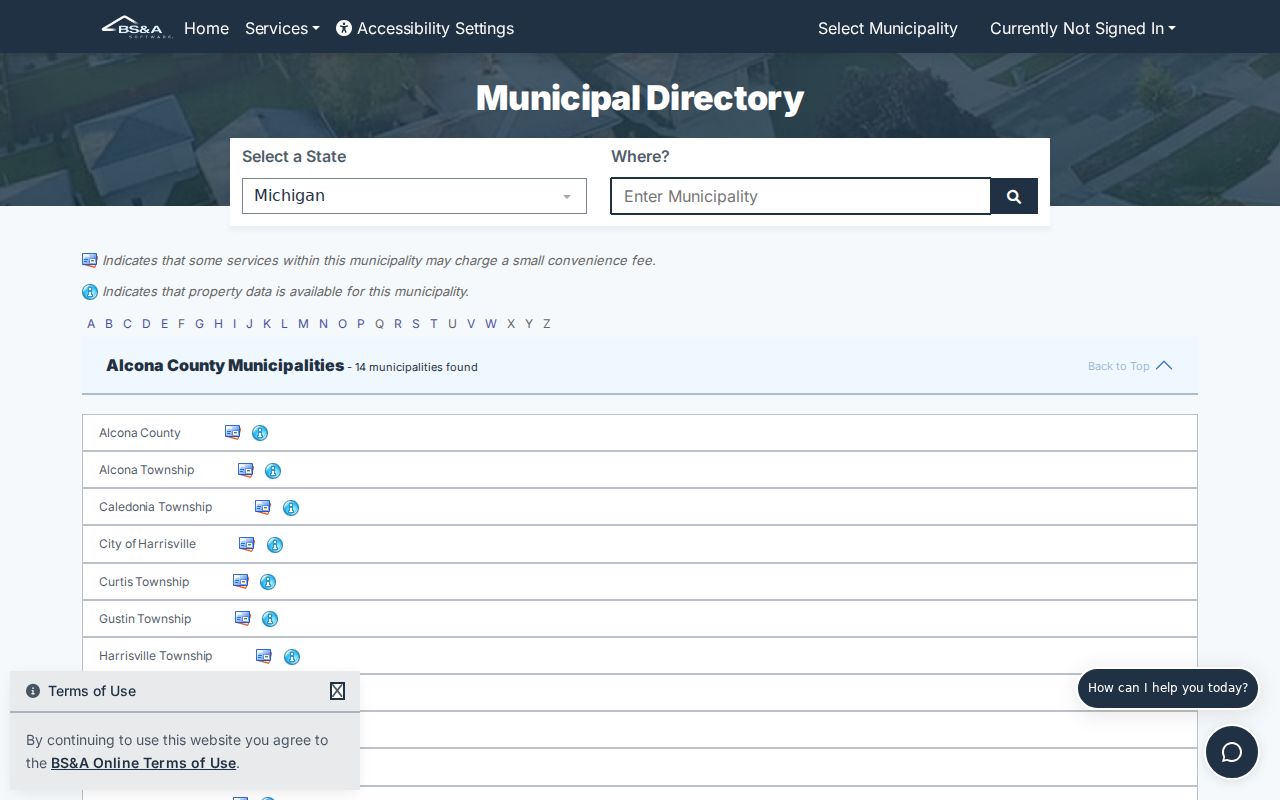
Tax status runs on its own lookup path, separate from the general property record. A missed parcel is common. If the portal does not return the expected one, try the complete PIN. Then try the address without over-specific owner initials. Call Equalization at 989-275-8121 for county assessment-report context. Or call the Treasurer at 989-275-5823 for taxes already transferred to the county. A written Michigan FOIA request can seek an identified non-exempt county record. Identify it by parcel, year, and record type. It cannot force the county to create a new analysis.
Trace a Roscommon Tax Bill
Start with the exact parcel, never a loose mailing-city match. Roscommon County's PIN is the bridge linking assessment, tax, GIS, and sale-list records. The county displays it in four hyphenated groups. It publishes no official decoder. Copy it exactly.
- Search BS&A by situs address and record the parcel number.
- Open the current tax route and note the tax year and payment status.
- Check the property tab for assessed, SEV, taxable, and PRE fields that are actually displayed.
- Use the delinquent route or contact the Treasurer if an unpaid year has transferred to the county.
- Assessed value
- A statutory assessment measure, generally half of true cash value in Michigan.
- Millage
- A tax rate expressed per thousand dollars of taxable value.
- Principal residence exemption
- PRE treatment that may exempt an owner-occupied principal residence from certain school operating mills.
- Tax lien
- A legal claim arising from unpaid property tax.
Separate Roscommon Tax Values
Michigan's State Tax Commission sets the standard. County equalization keeps assessments at 50 percent of true cash value. State equalized value, or SEV, reflects that equalized assessment. Taxable value can be lower. Annual increases stay capped. A transfer of ownership triggers uncapping in the next calendar year. This structure explains why two similar Roscommon parcels may carry different taxable values. Purchase price, assessed value, SEV, and taxable value each answer a different question. Recorded consideration in a deed index is not a current appraisal either. For the numbers without the bill mechanics, see the Roscommon County property value page.
Note: Always record the year together with the value label. A figure without both can mislead.
Roscommon Equalization Reports
Roscommon County Equalization publishes county and local-unit reports covering 2016 through 2026. It also offers parcel counts, apportionment, and millage material. The reports span every local unit. These include Au Sable, Backus, Denton, Gerrish, Higgins, Lake, Lyon, Markey, Nester, Richfield, Roscommon, and the Village of Roscommon. Use these totals to compare classes and units across the county. They do not replace a parcel card. When a parcel value seems off, save both the parcel-level record and the matching annual report so the assessor or review body gets a clear year, classification, and countywide context.
The reports also explain an important point. A county total and a local tax bill should never be expected to match. A report summarizes classes and units. A bill applies parcel-level taxable value plus the millage for the districts serving that parcel. Read the report for context, then return to the exact account for the amount due.
Roscommon's Three-Year Tax Cycle
Roscommon County runs delinquent taxes on a three-year process. Summer bills run July through September. Winter bills run December through February. Anything unpaid moves to the county on March 1, when a 4 percent administration fee and 1 percent monthly interest begin to accrue. From there the clock starts on a statutory sequence that ends, for some parcels, in foreclosure and public auction.
Notices keep coming in the first year. May, August, and October each bring a mailing. The second year escalates. A certified notice arrives, the parcel is forfeited in March, and title-search, recording, and newspaper advertising costs stack onto the balance while interest rises. Forfeiture does not mean the county sold the parcel. It is only a stage before foreclosure, and it can still be resolved.
Year three brings a show-cause hearing and sometimes a payment agreement before the March 31 foreclosure point. Because of that layered history, anyone reading Roscommon County property tax records should trace every delinquent year attached to a parcel. The Roscommon County Treasurer is the authoritative contact for payment, delinquency, and foreclosure status. Paying another owner's taxes never creates title.
Read Roscommon's Sale List Carefully
The 2025 property-tax sale list packs a lot into each row. Expect a parcel number, tax due, interest and fees, total due, current SEV, delinquent years, the address, and legal-description details. Treat it as a dated distress snapshot. It is not the complete tax roll. It is not a live offer list, either. Parcels get paid, redeemed, sold, combined, or corrected after publication.
The detail can run deep. One entry, parcel 004-012-002-0150, lists multiple delinquent years plus a section-township-range description with a split or combination note. Match records like that against the GIS map and deed records. Never assume a listed parcel is still available.
Verify before acting. Ask the Treasurer for current status and review the deed record before relying on an older sale-list entry.
Contest a Roscommon Assessment
Assessment disputes in Michigan start locally. The Board of Review in your assessing unit hears the first challenge. The Michigan Tax Tribunal handles qualifying property-tax appeals after that. Roscommon County publishes no single countywide filing date. Each local unit sets its own calendar, and property classification shapes the route. Read the current assessment notice and call the named assessing unit right away.
Good evidence wins cases. Bring the parcel card, the notice year, and the property classification. Add photographs of condition, measurements, comparable sales, and any document proving a factual error. An owner disputing a principal-residence exemption should take the separate exemption and Treasurer audit route. A value appeal will not fix the exemption.
Keep proof of filing and copies of every decision. The Board of Review and the Tax Tribunal serve different stages. The right path depends on the issue and the classification. Michigan Treasury publishes Board of Review guidance. The Tribunal publishes its own forms and procedures. An online estimate that disagrees with the assessor changes nothing by itself. Build the claim around the official appraisal. Use the correct year and evidence tied to the parcel number. The state appeal portal is the official destination for Tribunal filings. The assessment notice still controls the first local deadline.
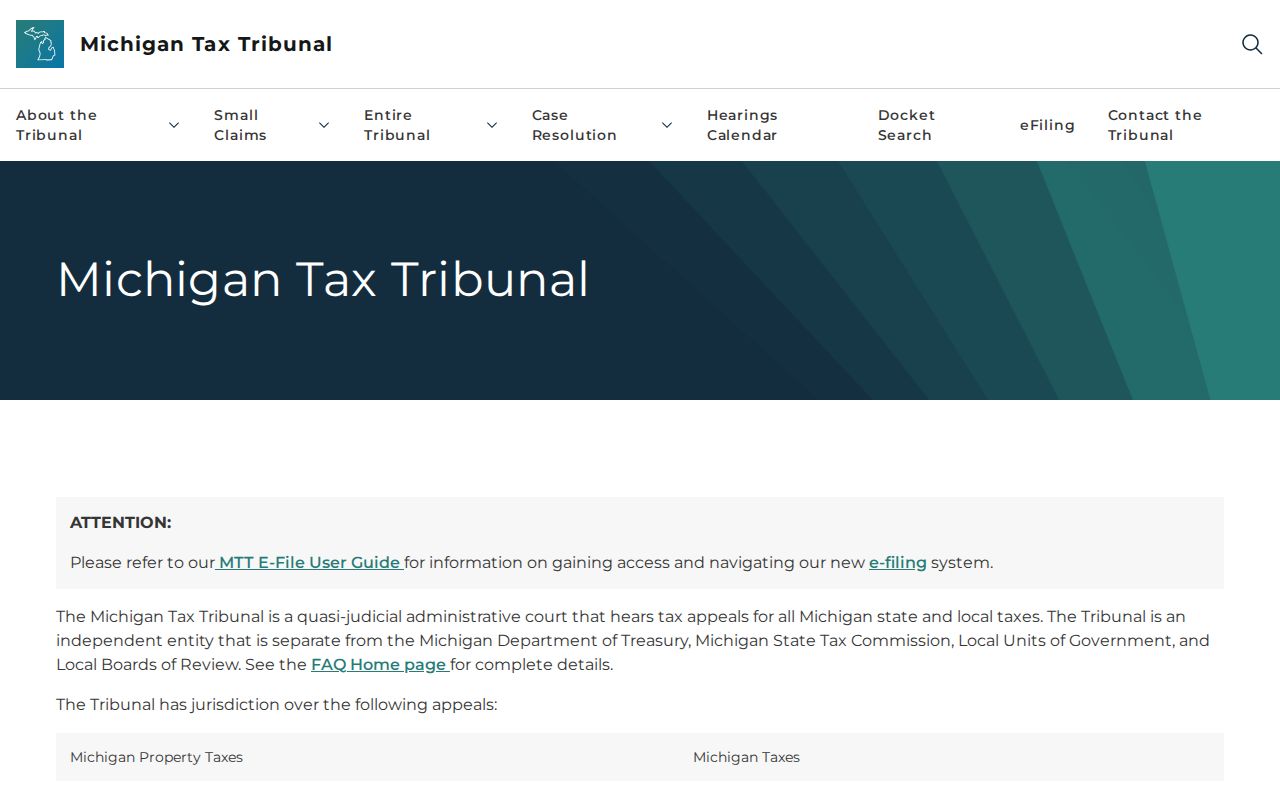
The state appeal portal confirms the tribunal route, but the assessment notice remains the source for the first local deadline.
Appeal window. File according to the notice and current local Board of Review calendar. No single Roscommon County deadline was verified for every assessing unit.