
Trace Roscommon Former Owners
Tracing former owners of a Roscommon County property means working through several eras of records. Start with the newest deed on file. Then walk backward, grantor by grantor, until the chain of owners runs out. The online property records stop answering at some point. Older deed books, microfilm, assessment rolls, plats, and dated newspapers keep the parcel search alive. Every source adds its own kind of ownership clue. A thorough property search leans on all of them.
| Source | Years It Covers | Where Held | What It Shows |
|---|---|---|---|
| GovOS and county online route | Current certification; FAQ describes 1969 forward | Register of Deeds | Parties, dates, document type, legal description, PIN |
| Deed index and books | Index 1852 to 1915; deeds 1852 to 1931 | FamilySearch films and courthouse originals | Earlier transfer chain and book-page references |
| Assessment rolls | 1874 to 1900; from 1920; from 1940 | Archives of Michigan | Owner and tax snapshots by assessment year |
| Plat books and newspapers | Named runs from 1885 through 2008 | State and local libraries | Lots, legal notices, sales, addresses, and local context |
Deeds are the backbone. They carry the actual proof of each transfer. Assessment rolls help bridge quiet years, though they never replace a deed. Plats hold subdivision, lot, and block identities steady. Even street names or parcel numbers shift over time. Newspapers round things out with notices and community context, but they are not title evidence.
Start With Roscommon's Latest Deed
First, pull up the current parcel in BS&A. Copy down the Property Owner name, PIN, situs address, and any legal description displayed. Next, open the GovOS deed index and search that owner as grantee, using the parcel number or legal description to pin down the right piece of land.
| Transfer date | Grantor to grantee | Deed type | Reference to preserve |
|---|---|---|---|
| Newest recorded date | Prior owner to current named grantee | Deed category shown | Document number and book-page |
| Earlier recorded date | Earlier owner to that prior owner | Warranty, quit claim, tax, sheriff, or estate event | PIN and full legal description |
| Book-era date | Named historic parties | Type stated in the volume | Volume, page, film, and DGS number |
Treat this as a method table, not a sample chain. Record only facts read directly from the actual index or volume. Note that instrument date and recorded date can differ, so save both.
Reconstruct Roscommon Ownership Backward
Every deed names two parties. The grantor gave up the interest, and the grantee took it. Strung together for one parcel, those instruments form the chain of title, and reading it backward from the newest deed while holding the legal description constant reveals each former owner of record in turn.
- Find the current named owner's acquiring deed and verify its land description.
- Record that deed's grantor, dates, document number, and book-page reference.
- Search the grantor as an earlier grantee, trying the LASTNAME FIRSTNAME format and name variants.
- Repeat with PIN, subdivision and lot-block, or section-town-range filters until the web trail ends.
- Continue with tract indexes, microfilm, and deed books using the last reliable reference.
- Reverse index
- An index organized to find the receiving or indirect party, useful when stepping backward.
- Legal description
- The land identity stated by lot and block or by section, town, and range.
- Quit claim deed
- A deed passing whatever interest the grantor held, without the same covenants as a warranty deed.
Narrow Roscommon Prior-Owner Names
GovOS advanced search lets you filter Roscommon County deed records by Grantor, Grantee, and Owner. Business Name, Deceased Name, and Party Names are options there too. Land-side fields include PIN, Property Address, and Legal Description. Document Number, Book, Page, and subdivision, lot, block, and section-town-range parts round out the set. Start with names. Add the parcel fields when a surname is common. The advanced grantor-grantee screen lays out every filter at once.
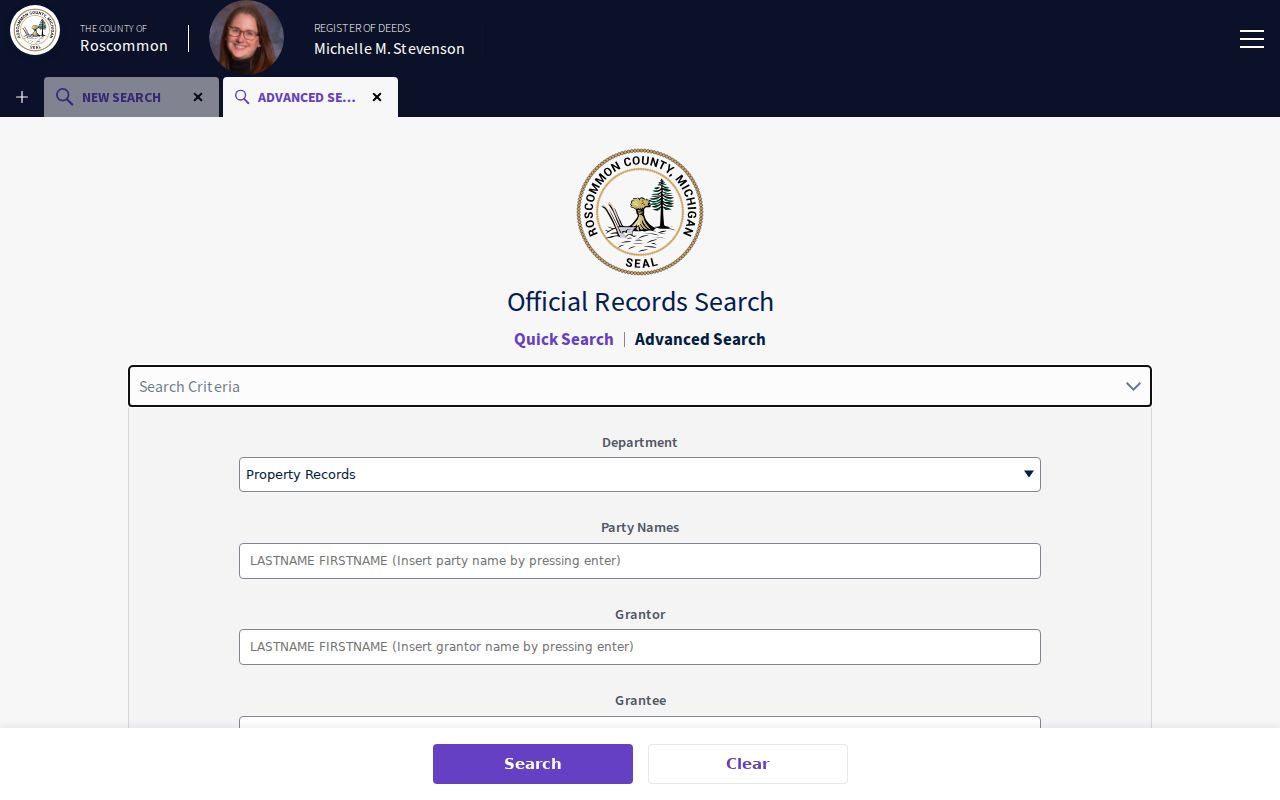
On the GovOS screen, a former-owner search can lock onto either party role and onto detailed land references at the same time. That flexibility matters in Roscommon County deed records. Try initials. Try a former surname, trust wording, or an entity name. A trustee, personal representative, or registered agent may hold the parcel under a label that differs from the named owner of record, so never merge two people just because their names match.
Enter Roscommon's Deed Books
The FamilySearch Roscommon catalog is titled "Deed records, 1852-1931; index, 1852-1915." Courthouse originals were filmed in 1974. Seven reels hold overlapping indexes and volumes, with early deed records reaching back to 1852. The index stops short of the latest filmed volume. Some years force you to browse volume notes rather than run one continuous name search. Plan for that gap before you dig in. Access can hinge on a FamilySearch account. It can also hinge on contractual limits or a visit to a FamilySearch Center. The Register vault offers another route, with public computers, microfilm, and tract-index books. Bring the last online grantor, an approximate date, the legal description, and a book-page reference. Those details cut down false starts in the deed records fast.
Online cutoff. The county FAQ describes 1969 forward, while older deeds survive on film and in books. No continuous pre-1969 public web run was verified.
Bridge Roscommon Deed Gaps
The Archives of Michigan guide catalogs Roscommon assessment rolls covering 1874 through 1900, plus runs beginning in 1920 and 1940. Each roll names the person taxed that year. That can bracket when ownership changed hands. Keep in mind a roll is a snapshot rather than a conveyance, so treat it as a clue. Confirm it with a recorded deed or probate order.
The guide also lists an 1884 state census, cemetery files, and GAR records. These collections can separate same-name people. They can also tie a former owner to a household or era, so contact the Archives of Michigan with the record group, year, party name, and parcel description in hand.
Follow Roscommon Plats and Descriptions
An old street address makes a fragile search key. A lot and block number or a section-town-range description usually serves you better. Michigan's Accela system has run the state plat-search route since January 2019. The Register of Deeds links to it from the county site. County records also hold PLAT, SURVEY, and LAND CORNER categories.
Named plats survive well in public records. One tax-sale record names Sovereign Park. Another official transaction identifies lots in the Third Addition. That addition sits within the Michigan Central Park of Higgins Lake. A similar name alone proves nothing. Compare the full description, township, block, and lot before assuming the parcels match.
Add Roscommon House-History Clues
Deeds show the transfer; newspapers often explain why. The Library of Michigan guide lists Roscommon News for 1885 to 1896 and partial 1902 to 1907 runs, plus Herald-News papers from 1912 to 1960, 1964 to 1980, and 1979 to 2008. Search legal notices, sheriff sales, obituaries, and ads.
The Roscommon Area District Library Michigan Room permits personal scanners and computers. Local material stays noncirculating. Staff copies cost ten cents. The Genealogical Society in Prudenville offers microfilm, family histories, six computers, and database access. Those resources make the offline search practical.
Note: Newspaper residence clues and tax-roll entries may name occupants or assessed parties, but neither replaces a recorded deed.
Find Roscommon's Timber-Era Clue
Roscommon County's archival guide catalogs "Statement of labor liens upon logs" covering 1881 through 1900. The series opens a rare window onto the county's timber-era economy. A prior deed or newspaper notice may mention logging claims. This series is not a modern parcel-lien index, though. Treat it as one clue among many.
Note down every party name, the year, record group RG 63-15, and any land description before moving on. Then test that clue against Roscommon deed books and assessment rolls. That discipline keeps a vivid historic record from being pinned to the wrong former owner of record.
Measure Roscommon Ownership Depth
Roscommon deed material in the catalogs begins in 1852. Official county organization dates to 1875. The county had earlier names and establishment steps, but those facts do not create a separate ownership chain. No courthouse fire, flood, or missing decade appears in official county sources. Never invent one to explain a dead end. Layer your fallbacks instead.
Start with current GovOS records, then the county's 1969-forward description, courthouse microfilm and tract indexes, FamilySearch deed films, historic assessment rolls, plats, and library collections. A professional title search is the right next step if a break remains. The Register will not determine chain of title.
Lawful use. Trace former owners for house history, estate work, or property diligence. Never use the record trail to stalk, harass, or target a living person.